

D’var Torah -December 5
 Shabbat Shalom! I pray this email finds you all well. Shabbat Shalom! I pray this email finds you all well. |
|
As children we’re taught some truly basic and quite frankly, beautiful concepts: “please and thank you”, “sharing is caring,” raising your hand if you want to be heard, shaking hands, giving “high fives,” being gracious, greeting everyone with a smile and a wave, saying “goodbye” at the end of the day, and saying “I’m sorry’ and “I forgive you”. If you continue to follow these amicable rules as you age, the expectation is that you’ll set the groundwork for becoming a decent, honorable, and valuable member of society.
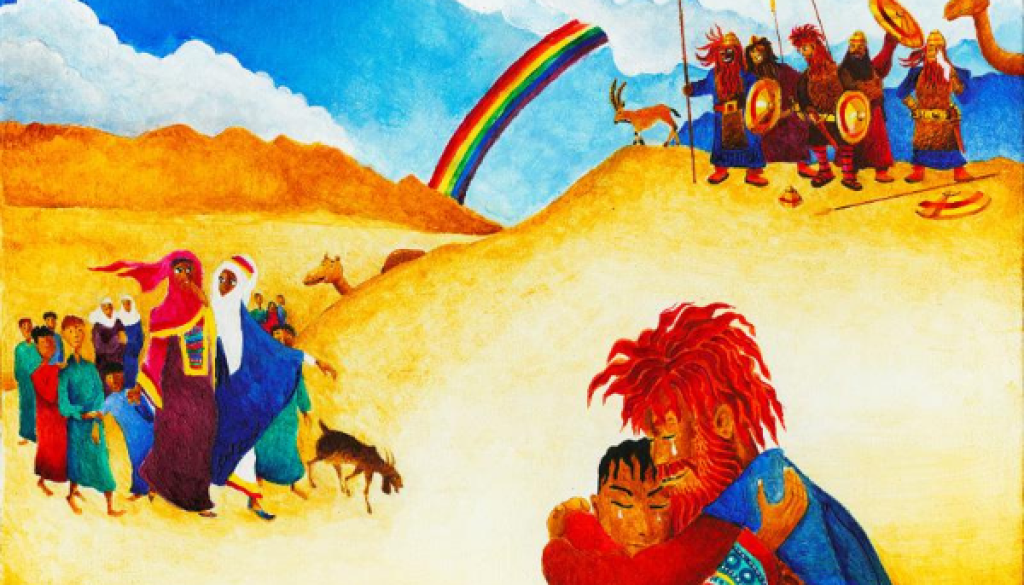
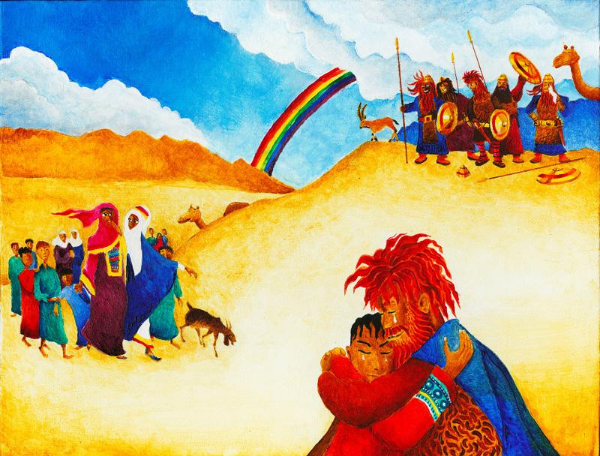
At this same developmental stage, however, we’re also taught concepts like “stranger danger,” don’t talk to people you don’t know, and have mom and dad inspect your Halloween candy before you eat it. In essence, we’re indoctrinated that you can’t trust everyone, not all people are good or have benign intentions, and that the world isn’t always full of kittens, puppies, and rainbows. In other words, we are being told to have a healthy and quite frankly necessary dose of skepticism, cynicism, defensiveness, self-preservation, and guardedness. So which one is it – be friendly, polite, welcoming, hospitable, trusting, and helpful or be cautious, skeptical, and guarded? In this week’s parsha of Vayishlach (Genesis 32:4-36:43), we see this conflict of values and priorities in real-time. Jacob, having just left Charan and returning home with his wives Rachel and Leah, his concubines Zilpah and Bilhah, and their children, receives word that his brother Esau is coming to meet him (Genesis 32:7). Jacob is rightfully alarmed, given their history, and makes whatever preparations he can, but he knows that he does not stand a chance against Esau’s 400-man army. When the brothers do reunite, there is no bloodshed, only warm embrace and affection (Genesis 33:3-4). After Jacob introduces Esau to his family, Esau suggests that Jacob and his family travel with him and his band (Genesis 33:12). Jacob responds that he must go at a slower pace due to his children and flocks (Genesis 33:13-14). When Esau then offers to provide his brother with an escort, Jacob politely refuses (Genesis 33:15). In the end, as Esau heads off to Seir, Jacob and his family purposely divert to Sukkot (Genesis 33:16-17). The reunion, reconciliation, family reunification..whatever you want to call it…it seems, is well, rather short-lived. If Jacob had followed Esau, would they have prospered together, or in the words of the Godfather, would Jacob and crew have ended up “sleeping with the fishes?” If the latter, was the dramatic reunion and emotional reconciliation simply an elaborate ploy by Esau to lull Jacob into a false sense of safety? Jacob is no dummy, as we have seen, and one cannot blame him for erring on the side of caution. After all, in in the earlier parsha of Toldot(Genesis 25:19-28:9), we are told: “Now Esau harbored a grudge against Jacob because of the blessing which his father had given him, and Esau said to himself, ‘Let but the mourning period of my father come, and I will kill my brother Jacob.’” On the other hand, did Esau truly love his younger brother and had he forgiven him, thus rescinding his earlier pledge to kill him? If this is the case, Jacob’s departure is a lost opportunity for a renewal of brotherly love and bonds of affection. |
| Rabbis from the Rashbam to Chizkuni, the Malbim, and Shneur Zalman of Liadi have all debated what was truly in Esau’s heart and what his real intentions were [1]. Jacob obviously didn’t want to stick around and find out.
The question remains: in life, are we supposed to be gregariously welcoming and friendly, or conversely guarded, jaded, suspicious, and cynical? To this end, the great Rabbi Rambam taught, “Anyone who follows a middle course is called a sage” [2]. In other words, we must not treat everything as a threat, every situation and encounter as hostile, and everyone as a potential adversary, nor can we treat the world as one unending big ball of happiness.We must be willing to take risks, calculated risks to be sure, and open ourselves up to new possibilities and adventures, but not do so blindly. If we take the Rambam’s middle ground, then we create the possibility of living a full and safe life. Bizrat HaShem, with God’s help, may we all follow a middle course in 2026. |
| Wishing you all a Good Shabbos and a great weekend. |
| Bivrakha, |
| Rabbi Aaron |